As Ukrainian Tennis Players Continue to Storm the World Rankings, Each New Success Story Becomes a Masterclass in Resilience and Character.
Yuliia Starodubtseva Is a Prime Example. Her Recent Performance on the Clay Courts of Paris Proved That She Isn’t Just Ready to Compete With the WTA Elite—She’s Ready to Beat Them. Her Fantastic Second-Round Clash Against Elena Rybakina Became That Ultimate Turning Point, Establishing Yuliia as a Serious Threat to Any Top-Tier Opponent.
Today, right in the thick of the grass-court season at Wimbledon, we have an exclusive chat with Yulia. We talked about her transformation, stepping up to a completely new level of play, the inner workings of professional tennis, and the real price you pay for big victories.
— Yuliia, hi! Let’s start with your incredible performance in Paris. When you looked at the draw and realized you were facing Rybakina in the second round, what was your immediate thought? Was it pure excitement, a dream challenge, or did you feel the pressure?
This might sound like a boring answer, but I actually never look at the draw. I only focus on my immediate next opponent. After a match, I usually just rest, recover, and only then do I find out who I’m playing next. I even ask my team not to tell me who’s coming up. Sometimes I accidentally see draw updates or potential matchups on social media, so I try to limit my screen time during tournaments just to keep my mind as relaxed and clear as possible.
The day after the first round at Roland Garros, when I found out I’d be playing Rybakina, it was a really interesting feeling. I had never played against a World No. 2 before; my only previous top opponent was Coco Gauff.
It’s a completely different level of tennis—she is incredibly talented with massively powerful shots, and you never quite know how well you’ll be able to resist that. I had never even practiced with her. So I was really excited; it was more about curiosity than nerves. It was a chance to test myself against the best. I never had a feeling that I couldn’t win. In fact, right before the match, I felt like it was going to be my day. And that's exactly what happened.
— What was your mindset going into that match? How did you prepare for it?
I prepared the exact same way I do for any other match. I don’t believe in preparing harder just because an opponent is highly ranked. To me, every player is a peer on the court, and I try to maintain a neutral attitude. If you think an opponent is weaker, you’re not going to warm up or prepare any less, right? So my routine stays identical.
My team and I analyze every opponent’s game beforehand, and we had a specific game plan for this match too. Usually, we discuss the tactical details about an hour before we walk out, so I don’t overthink it for too long. If there’s a rest day, we might work on specific elements during practice, but that one-hour-out meeting is where we cement the concrete plan I try to keep in my head.
“I never had a feeling that I couldn’t win. In fact, right before the match, I felt like it was going to be my day. And that's exactly what happened.”
— What did you feel, and what went through your mind when you finally got some moments alone after the match?
I didn't get any time alone because my phone completely blew up! (laughs) Of course, I was incredibly happy, and there were so many messages right away from my parents and friends. I tried to reply to my inner circle first, but suddenly your whole social media is just flooded with you.
While that’s incredibly sweet, it also drains a lot of energy. Plus, you’re still in the tournament. Everything goes on—it wasn't the final, and it didn't mean I had already achieved everything. So, I used my day off to just soak in the victory and the feelings, and then I reset to think about the next round from a calm place.
I think it was only after the tournament ended that I fully processed how successful of a run it was, and how much confidence that massive win gave me.
— What did your coach say to you right after the match?
Nothing crazy! (laughs) He just said I was a "super superstar," but you could see how incredibly happy and thrilled he was just by his emotions.
— What changed for you after that match? How did it affect you? Did you start expecting more from yourself, or did you feel a spike in pressure? Or did it just purely boost your confidence?
Confidence, for sure. When you beat a Top 10 or Top 5 player, you realize that you belong on the same court and can play at that exact level. As for expectations, I think I was ready for this challenge. Most tennis players face self-imposed expectations and deal with them in their own way, myself included.
But I actually went through that phase last year, and I’m learning that playing with too many expectations makes tennis really hard. Every single player—not just in the Top 10, but even in the Top 150—plays incredibly well, and you can lose to anyone on any given day. You can never underestimate an opponent or expect a guaranteed win just because your ranking happens to be higher. I try to stay neutral and just take it day by day, practice by practice.
— Do you manage to maintain that neutrality?
Sometimes I forget, but I always remind myself and snap back to it. Overall, I handle it pretty well.
“When you beat a Top 10 or Top 5 player, you realize that you belong on the same court and can play at that exact level.”
— What are your methods for building mental strength and resilience? Is experience the key here?
100% experience. This is my third year on the professional tour. My second year was really tough because I expected too much from myself. My first year had a lot of wins and everything went so smoothly, which gave me a false sense that it would only get easier. But the opposite happened. I expected too much, which brought a lot of negativity.
That experience taught me to keep a neutral perspective on everything in my career. But as for specific mental techniques or exercises? No, I don't really have any.
— How much do you think success depends on raw character versus self-improvement?
I think for every player on tour, character makes up a massive percentage of success. To break through and reach this level without a strong character is practically impossible. But those who reach the Top 20 usually add that extra layer of meticulous self-improvement. At that level, it’s literally about 1% or 2% differences that decide everything. Tweaking very tiny details within yourself can be the catalyst for the next level. Very few people manage to do that, and I feel like I am going through that exact stage right now.
— What percentage of a result depends on the mental game versus physical fitness? And how much time do you dedicate to each?
When it comes to women's tennis, the mental side is definitely more critical than raw physical strength. I'd say it’s 75% mental and 25% physical.
For me, mental exercises are much harder than physical ones. I can easily push myself to my absolute limits physically. But when it comes to mental challenges, not many people are truly ready to face them.
Maybe I don’t have enough resources or information yet on what options exist in this area. With what I know and can do now, it’s still tough—sometimes it’s hard to even notice or consciously register the moments you need to work on. When I catch myself in a moment where I know I need to push through or make a different decision, I fight through it internally. All these diverse efforts and constant work eventually add up to a better mindset for the next match.

“Tweaking very tiny details within yourself can be the catalyst for the next level. Very few people manage to do that, and I feel like I am going through that exact stage right now.”

— What was the biggest mental slump of your life, and how did you crawl out of it?
Probably last year. At the start of the year, I couldn’t win a single match for the first two months. It was brutal—you practice before a tournament, prepare, and then lose in the first round. Then you go to another tournament, practice, prepare, and lose again. After doing that five or six times in a row, you start thinking this sport just isn't for you.
That’s when I started working with a sports psychologist, and my results improved immediately—I won two matches back-to-back. I worked with him for a year, and now I only reach out when there’s a very specific situation or a question where I need someone to highlight things I might be missing. Right now, I feel like I understand my own processes quite well, and there isn't a slump or a problem I can't solve on my own.
Ultimately, a psychologist doesn't fix things for you; they just give you the tools. You’re the one who has to do the heavy lifting. Right now, I know what I need to work on, so I don't need regular therapy sessions.
— How do you mentally unplug and unwind to recharge for this endless cycle of training and matches?
During tournaments, it’s pretty tough because there are no non-tennis friends around. I’m constantly with Pearse, and since he’s my coach, he is also associated with tennis, so almost all our conversations revolve around it (laughs). So in my situation, it’s tricky.
I love being by myself, going for walks on the beach, or doing some shopping. Right now, my new favorite thing is going to a spa. If there’s a good option nearby, I’m definitely going. It helps me so much... the sauna and massages just relax me and make me forget about tennis for a bit.
But overall, it depends on what’s available. For example, here in London, I have a close friend from college. We’ve been tight for a long time, so I’ve been spending time with her and her friends. Anything outside of tennis helps restore my energy.
“Ultimately, a psychologist doesn’t fix things for you; they just give you the tools. You’re the one who has to do the heavy lifting”
— WHAT ARE YOU MOST GRATEFUL FOR IN LIFE?
The opportunity to play tennis. And having such wonderful parents and friends. Honestly, for everything I have. I’m the kind of person who doesn't easily forget the great things that happen to me. They say, "the amount of beautiful things that happen in life, depend on your ability to see them." I'm grateful for everything, but mostly for the chance to play tennis, because it made my life so incredible.
— WHAT ADVICE WOULD YOU GIVE YOUR 17-YEAR-OLD SELF?
Study finance! (laughs)
— WHAT DID YOU STUDY IN COLLEGE IN THE US, AND HOW DID YOU CHOSE YOUR MAJOR?
First, I did four years of International Communication for my bachelor's, and then Sport Management for my master's degree. Since math and I never really got along, I initially picked a major that had the absolute least amount of it, so I could focus more on tennis. But my master’s was a conscious choice, and it also gave me the chance to learn another language—German.

— Would you advise young tennis players to take this route, or is it more of a situational choice?
It's a tough question, but I think if a player is already ranked in the Top 100–200 at 17 years old and is in peak form, there’s no point in disrupting that path; you can get an education later or in a different way.
Personally, I love the college route because it allows you to mature and develop as an individual, which later gives you a huge edge on tour in terms of being ready for life’s challenges. I don't know how juniors can be expected to be ready for all of this right away. So I would recommend my path, but maybe for two years instead of four or five.
I always planned to play professionally, but after two years in college, I actually started losing motivation because I realized just how expensive the pro tour really is. I wasn't sure if I’d commit to it or not, but I still tried to be one of the best in college because it’s highly prestigious and valued in the US.
— How did your collaboration with your coach begin?
It started completely by accident. I initially came to Europe to work with a different coach. But he wasn't the right fit for me, even though I didn’t realize it at the time. He was a high-level professional, but on a personal, human level, it was tough. Then Pearce, whom I had already been dating for over three years at that point, started coming to my practices.
At first, he just watched without commenting or stepping in. But whenever my coach couldn't make it, Pearse would fill in and coach me, pointing out the exact same technical things the other coach did. The advice and the training style were practically identical, but with Pearse, it was just infinitely more comfortable.
That’s when I suggested we try having him coach me for a bit, which also solved the issue of being in a long-distance relationship. We gave it a shot, and ultimately, the biggest breakthroughs of my career happened with Pearse.
— Did you meet in college?
Yes, he transferred to my college for his final year of eligibility. He played for the men's team, and I played for the women's.
— Tell us about your own experience coaching.
After graduating, we went to work at a tennis club in New York for a year because I needed to complete an internship for my major. It was also a chance to save up some money to fund my tournament travel. It was an interesting experience because when you coach someone else, you actually start to better understand how to fix errors in your own game.
— Do you manage to separate your personal relationship from tennis?
We try to. Sometimes it’s hard, especially for him. When I misbehave on court—which happens from time to time—he might carry that mood back home after practice. But most of the time, we make sure things don't get messy, and we agreed from the very beginning that if this started negatively impacting our relationship, we would stop working together as player and coach. So far, everything is great.
— What is the most important thing your coach has taught you?
That there is always so much more to learn in tennis—both for me as a player and for him as a coach—and that there is no ceiling to this learning. There is always something to refine, and we aim to get 1% better every single day.
— Are marriage and a wedding important to you? What do they mean to you?
Not really. We feel so comfortable in our relationship... we aren't in a rush. Even when we talk about it, we honestly don't see when we could even pull it off because we have virtually zero free time (laughs). I'm definitely not one of those girls who grew up dreaming about a wedding.
“We agreed from the very beginning that if this start negatively impacting our relationship, we would stop working together as player and coach. So far, everything is great.”
— What have you had to give up for your professional career?
Going out. When me and Pearce were working as coaches in New York, we loved going out on weekends, but now that’s completely off the table. I guess I'll do my partying after I retire! (laughs)
— How and when did your big career breakthrough happen? What specific actions or changes triggered it?
It's hard to pinpoint just one thing... I think it's more about that 1% daily effort that accumulates over time and eventually translates into a massive jump in results. You fine-tune your forehand in practice, you push through a critical turning point in a match and grow stronger mentally... and eventually, it all clicks together.
— What does it feel like to realize that you are one of the best tennis players in the world?
I don’t even think of myself that way yet! When I make the Top 10, ask me again and I'll give you an answer! (laughs)
— Do you have a specific goal for your tennis career or for this year?
My only goal is to continuously become a better player, physically and mentally. The goal for a year can be to commit to a specific style of play and stick to that plan all season—being consistent and disciplined with it.
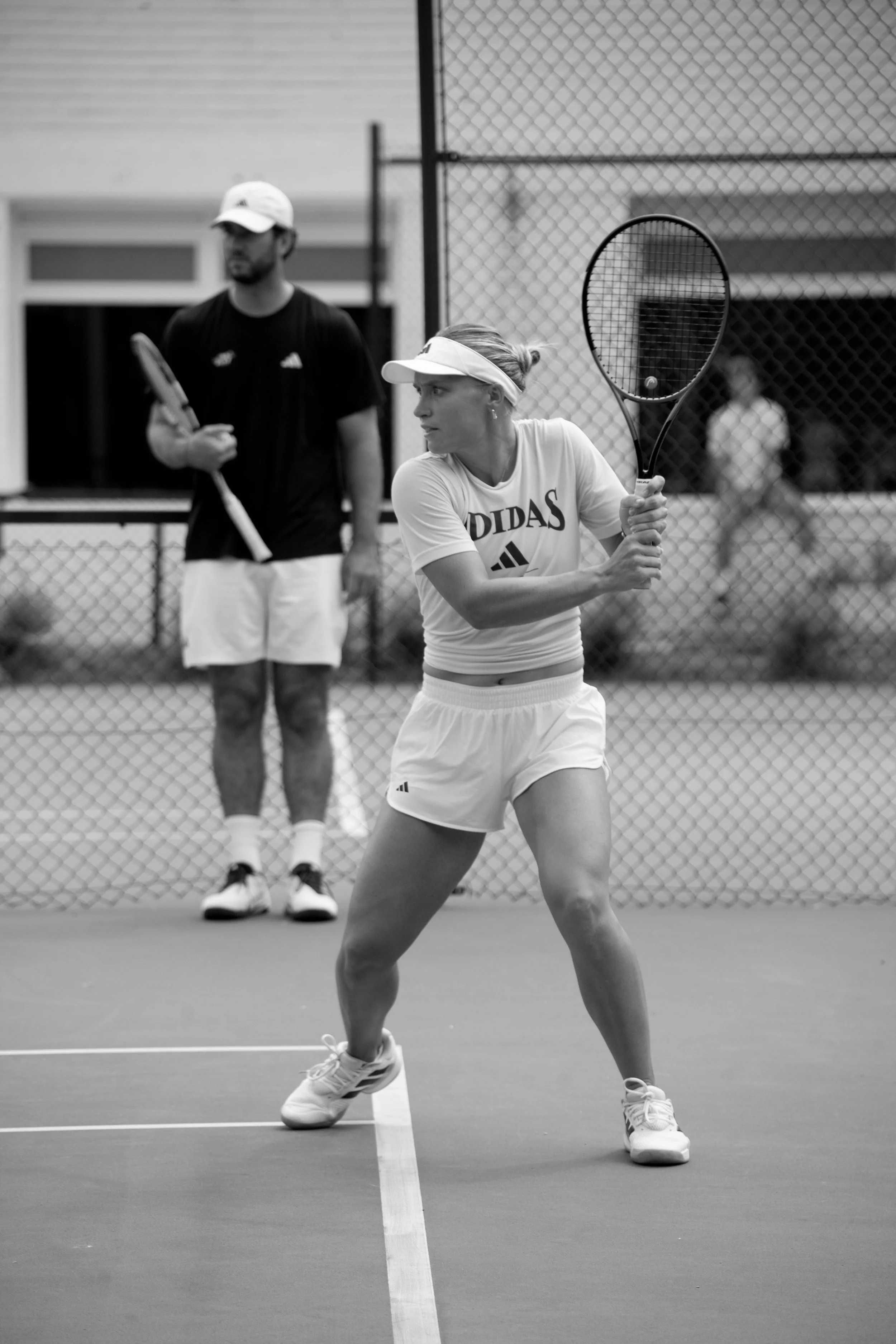
Of course, the dream is to become No. 1 and win a Grand Slam, but I don't set that as an explicit goal; it’s a dream. My actual goal is to push myself to maximize my absolute potential as a player. That’s just my mentality on the matter. I will do everything within my power, and then we’ll see where it takes me.
“My actual goal is to push myself to maximize my absolute potential as a player.”
— Do you watch women's tennis matches? How big of a role does scouting your opponents play in your routine?
When I’m at Grand Slams, I might watch, because I’m already fully immersed in the environment anyway. But during other tournaments or weeks off, I don’t watch at all because there’s already too much tennis in my life. If I’m in the mood and have time, sure, but usually, it just drains energy.
I also hate rewatching my own matches—especially the ones I lose—to analyze them. Pearce forces me to do it sometimes, of course, but I really don't enjoy that part. He usually watches most of my opponents' matches to get me tactically prepared. Personally, I prefer watching old vintage matches on YouTube.
— How and when did your contract with Adidas Tennis come about?
At the beginning of 2025, right before the Australian Open. I had started working with the 72 tennis agency, and they found a few brands interested in a sponsorship deal. But Adidas resonated with me the most, so I’m incredibly happy with how successfully it all came together.
— How much does the financial side of pro tennis—touring costs, coaches, physios—impact your athletic decisions, especially early in your career?
It impacts it massively. Even now, I have a physio traveling with me whom I can finally afford to pay. He’s younger, and works through a clinic I trust. He helps me tremendously, and his rate is more accessible to me than the specialist I used to work with.
Lately, I’ve been feeling like my body desperately needs constant, high-quality recovery, so I really didn't want to cut corners there. At the same time, I have a second coach I wanted to bring on tour, but paying two coaches and a physio every single time is just too expensive. You constantly have to choose which team members go to which tournaments.
It's especially tricky when it's a WTA 250 event, where the prize money for reaching the final is basically what it costs to pay your team for the week. That math is always running in your head. But despite that, I think I manage my finances very well and invest heavily in myself and these components because, as I said, I want to see the absolute ceiling of my potential.
Only players in the Top 40 can really afford to stop worrying about these expenses and breathe easier because they have highly lucrative sponsorship deals. Once you're there, you don’t have to calculate which airline to fly—whether it's a budget carrier or Air France, for example (laughs).


“Only players in the Top 40 can really afford to stop worrying about expenses and breathe easier because they have highly lucrative sponsorship deals.”


— When was the last time you were home, where do you live now, and where is your dream spot to buy property?
The last time I was home in Ukraine was in 2022, exactly one month before the russian full-scale invasion started. Because of the war, I haven’t been able to visit my city and my home since. Of course, I miss Ukraine deeply, but without the possibility of actually going to my hometown right now, I’m not planning a trip.
My dream is to buy a house in Australia right on the ocean. I already see references on social media of things I love (laughs), so I have a very clear picture of what that dream looks like.
— Favorite movie, series, book, and music?
Series: Peaky Blinders.
Book: The Inner Game of Tennis.
Movie: Angel-A.
— Your favorite tournament and its location? And which city is unfairly missing a tournament?
I absolutely love Wimbledon. It is uniquely beautiful... everywhere you look, it's stunning. The atmosphere is so royal, and I really love playing on grass.
Monaco is definitely missing a tournament. The men have one there, but the women don't—it's totally unfair!
— If you had to pick a completely different sport or profession, what would it be?
I’d be a businesswoman (laughs). I’d own my own beauty salons or a real estate company, and spend my free time doing Pilates. A total dream job, but that’s for after my tennis career.
— Describe your ideal day, from the moment you wake up to the end of the evening.
I wake up in my house where I have a flawless green lawn, and I go do my yoga. Then I have breakfast with fresh berries, drink my coffee, and head off to manage my real estate business (laughs). After that, I get a massage and a spa session. To finish the day, Pearce and I watch a TV show and just relax at home (laughs).

— When did you realize that tennis was serious—that you wanted it to be your life's work?
Probably during my first year playing professionally after college, when I realized I could consistently beat Top 100 players. That’s when it hit me that I was ready to fully commit my life to this career.
— And the final question... Who introduced you to tennis, how, and when?
My dad brought me into tennis when I was five. He used to constantly tell stories about how Serena Williams played and how much money she made. So he put my sister and me into tennis so that one day we could buy him a yacht. We've almost achieved it, just a little bit left! (laughs)
***It's a beautiful goal that once started with stories about Serena Williams and has since transformed into your own unique journey in world tennis. You mentioned you’ll only consider yourself one of the best once you break into the Top 10—so we sincerely wish you a swift climb to the top, while keeping that wonderful inner neutrality and harmony. Thank you for this chat, and best of luck in the for the rest of the season!
Interviewer & photographer: A.Belova